In This Article

Validium is an Ethereum scaling solution that ensures transaction integrity using zero-knowledge rollups (zk-Rollup) technology, but without storing transaction data on the mainnet. Even though data availability (DA) in validiums is moved off the mainnet, which harms decentralization, a big advantage of such solutions is significantly improved scalability.
Typically, validiums use validity proofs such as zk-SNARK (zero-knowledge succinct non-interactive argument of knowledge) or zk-STARK (zero-knowledge scalable transparent argument of knowledge).
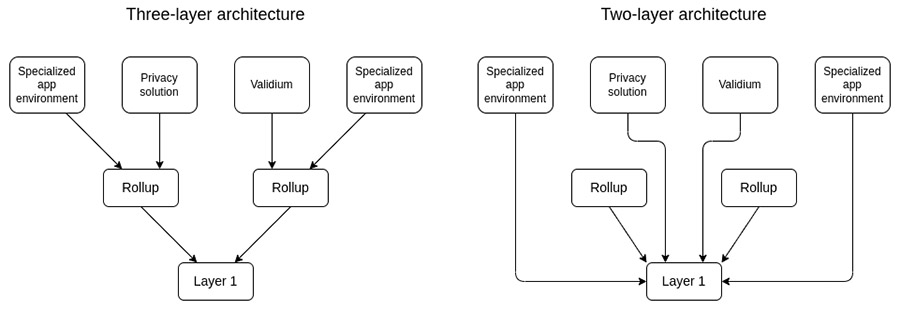
Depending on the architecture used, validiums can be either Layer 2 solutions (Layer 2) that scale the Ethereum network directly, or Layer 3 solutions (Layer 3) deployed on top of ZK rollups such as zkSync Era, Polygon zkEVM, Linea zkEVM, and so on.
How do validiums work?
User funds held in a validium are controlled by a smart contract deployed on the Ethereum mainnet. Like zk-Rollups, validiums allow nearly instant withdrawals. As soon as a withdrawal request proof is verified on the mainnet, users can withdraw their funds by providing a proof in the form of a Merkle root. The Merkle root confirms the inclusion of the user’s withdrawal transaction in the verified batch of transactions, allowing the on-chain contract to process the withdrawal.
Even though transactions are executed off-chain, a validium is governed by a set of smart contracts deployed on the mainnet:
- Verifier contract. The verifier contract checks the validity of the proofs submitted by the validium operator when updating the state. This includes validity proofs confirming the validity of off-chain transactions and data availability (DA) proofs confirming that the data exists.
- Main contract. The main contract stores the commitments (Merkle roots) submitted by block producers and updates the validium’s state after the validity proof has been verified on the mainnet. This contract also handles deposits into and withdrawals from the validium.
Validium security
Like other Ethereum scaling solutions, validiums rely on the security and settlement of the mainnet. Ethereum serves as the primary settlement layer that guarantees the validity of state transitions. Transactions executed in a validium cannot be fully confirmed until Ethereum verifies their validity. Once transactions are finalized on the mainnet, they cannot be altered or reversed in the validium. If the verifier contract deems a proof invalid, any transactions are rejected. This means operators must satisfy the validity conditions established by the Ethereum protocol before updating the validium’s state.
Data availability in validiums
Transaction data in validiums is not sent to Ethereum; instead, they use their own solutions. Thanks to the small amount of data transmitted to the mainnet, validiums are not limited by Ethereum’s throughput and can reach 9,000 transactions per second (TPS). In addition, this solution allows significantly lower fees for users.
Nevertheless, the off-chain data availability model presents a fairly significant challenge, which each validium solves in its own way, using its own data availability layer or resorting to third-party services. Read more about the data availability problem here.
Advantages and disadvantages
As with any other solution, validiums have both positive and negative aspects. Let’s take a closer look:
| Advantages | Disadvantages |
|---|---|
| ZK validity proofs ensure the integrity of off-chain transactions and prevent operators from committing invalid state updates. | Specialized hardware is required to generate validity proofs, which increases the risk of centralization. |
| Fast withdrawals from the validium back to the Ethereum mainnet. | Limited support for general-purpose smart contracts. Specialized programming languages are required for development. |
| Immune to certain types of attacks that other solutions may face. | Generating ZK proofs requires high computational power, which is not cost-effective for low-throughput applications. |
| Low gas fees for users, thanks to the fact that data does not need to be published on the mainnet. | Slower transaction finality time (10–30 minutes to generate a proof), but faster achievement of full finality. |
| Suitable for trading or blockchain games where privacy and transaction scalability are prioritized. | Users can be prevented from withdrawing funds, since generating proofs requires possession of the Merkle root so that off-chain data is available at all times. |
| Provides higher throughput and increases scalability. | The security model relies on trust assumptions and cryptoeconomic incentives, unlike ZK rollups, which rely exclusively on cryptographic security mechanisms. |
Existing examples of validiums
At the moment, there are very few fully operational validium solutions on the market, since launching them on the mainnet requires solving many security-related problems. Nevertheless, development of such solutions is ongoing, and some of them can be highlighted:
1. Avail
Avail is a modular blockchain from the developers of Polygon. It uses zero-knowledge rollup (zk-Rollup) technology to send proofs to the Ethereum mainnet, but uses a Data Availability Committee (DAC) for storing transaction data.
Avail’s native token:
2. Immutable X
Immutable X is a Layer 2 scaling solution designed to optimize and scale Ethereum. The network enables gas-free transactions and focuses on the gaming industry.
Immutable X’s native token:
3. zkPorter
zkPorter is an L2 scaling protocol from Matter Labs, the developer of ZKSync. It provides data availability through a hybrid mechanism that combines ZK rollups and sharding.
zkPorter’s native token:
- The token has not been launched yet