In This Article

Zero-Knowledge Proof is a cryptographic protocol that allows one to prove that a statement is true and that the proving party knows it, without providing information confirming this statement to the verifying party. The difficulty of this proof lies in the need to demonstrate the existence of certain data without revealing its contents.
For a protocol to truly be one, it must possess the following three properties:
- Completeness. If the statement is indeed true, the prover is obliged to convince the verifier to any given degree of certainty.
- Soundness. Otherwise, if the statement is not true, no prover will be able to convince the verifier (with the exception of a very small, negligible probability).
- Zero-knowledge (ZK). If the statement is true, no one will be able to learn any information other than the fact that the statement is true.
Zero-Knowledge Proof (ZKP) is not a mathematical proof, since there is always an extremely low probability that the proving party will be able to convince the verifying party of a false statement (false soundness). Put simply, a zero-knowledge proof is not a deterministic proof, but rather a probabilistic one. Nevertheless, there are methods and algorithms that make it possible to reduce the probability of a “soundness error” to such a low value that it can be neglected.
ZK Protocol Algorithms
Two main zero-knowledge protocols can be identified, which are used most often:
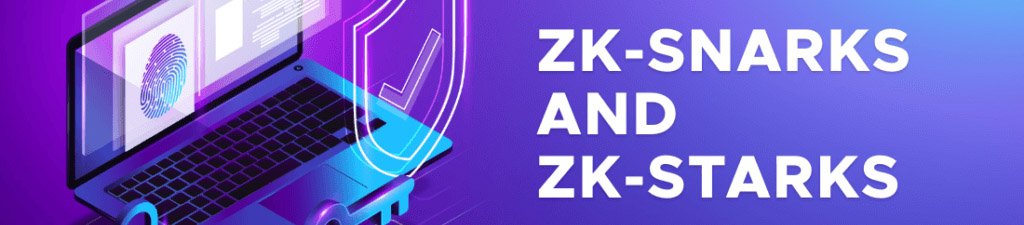
- zk-SNARK (Zero-Knowledge Succinct Non-Interactive Argument of Knowledge) – a succinct non-interactive argument of knowledge with zero disclosure. The proving party can prove possession of information using a secret key while in no way interacting with the verifying party. The secret key is destroyed immediately after the trusted setup.
- zk-STARK (Zero-Knowledge Scalable Transparent ARguments of Knowledge) – a succinct transparent argument of knowledge with zero disclosure). Unlike ZK-SNARK, it does not require a trusted setup, and the randomness used is publicly available information.
Advantages
- Increased user privacy.
- Improved information security.
- Increased throughput and scalability of blockchains.
Disadvantages
- These algorithms require significant computing power to operate.
- There is a small probability of compromise during the trusted setup.
- Potential vulnerability to quantum computing.
Where Is ZK Used?
- ZCash uses a modified zk-SNARK protocol to increase the privacy of users’ transactions.
- The companies Resistance and StarkWare are developing solutions for operating decentralized exchanges based on zk-STARK.
- Polygon has launched the Miden VM virtual machine, which runs on the basis of the zk-STARK protocol.
- The Dutch bank ING uses a modified version of the Zero-Knowledge Range Proof (ZKRP). This modification of the protocol can prove that a bank’s client has a salary within a certain range that allows them to take out a mortgage loan, without revealing the exact amount.
The application of zero-knowledge proofs does not end there; numerous cryptocurrency projects are developing solutions that use these protocols to one degree or another.